Automated regression testing for your backend migration
Ripplo maps your application's user workflows, builds tests for them, and alerts you the moment the migration breaks one.
A successful backend migration depends on test coverage.
- Backend migrations change behavior deep in your stack — on a server-rendered app, it surfaces straight in the HTML your users see.
- The dangerous changes don't crash. Type coercions, encoding boundaries, and API behavior shifts —
5/2 → 2.5, str/bytes, dict ordering— often succeed silently but return subtly different results. - Haphazard manual or agentic testing won't plug this gap — the surface area is too large and the results too brittle to trust.
Migration from Python 2 to Python 3
Unicode decode crash
A UnicodeDecodeError on accented input takes down the whole page render — one bad field kills everything.
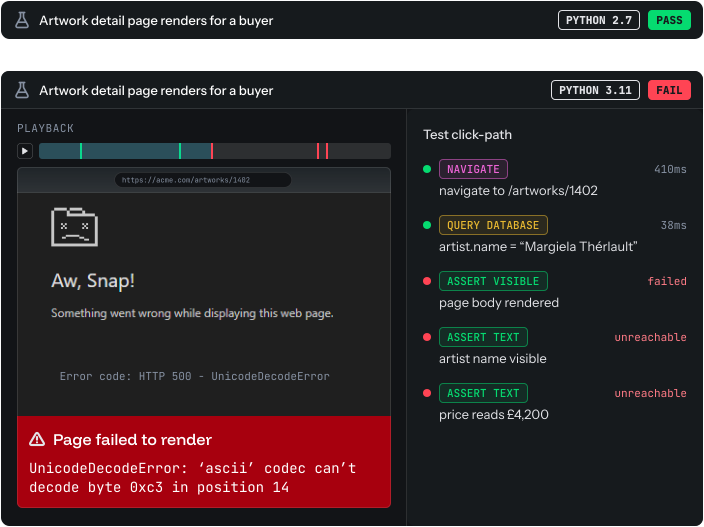
Four things that matter during a migration.
Coverage you can verify
We review browser events, network calls, DOM mutations, and server-side activity from your staging environment to ensure our tests cover all the moving parts of your application.
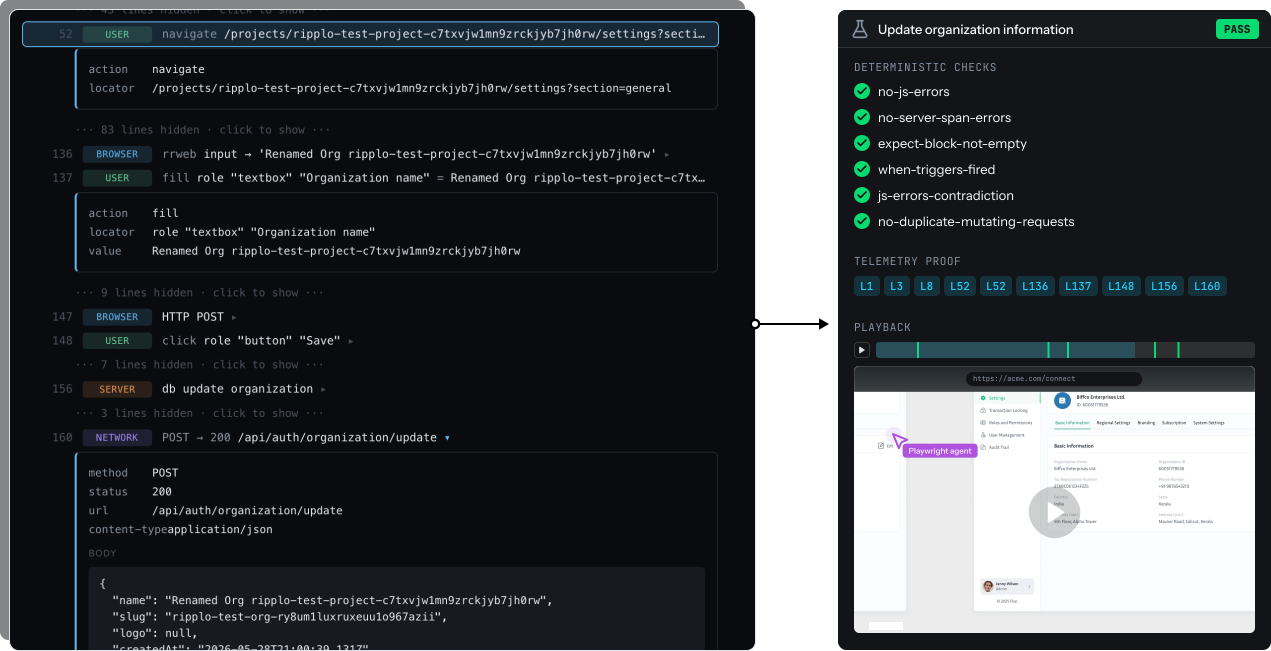
Tests are human legible
We link successes to a screen capture and an associated list of state checks. We link failures to the exact request, response, and UI state that changed.
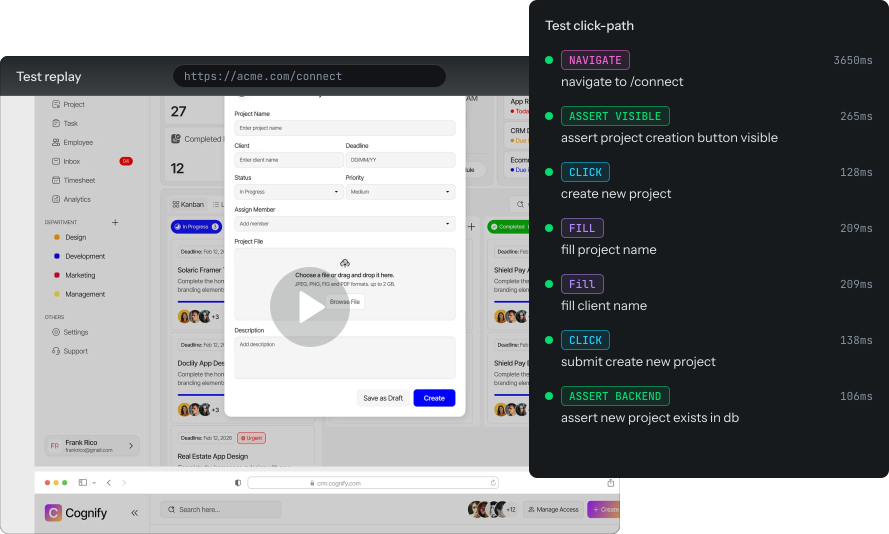
The same workflows run on both backends
Point the suite at the old backend and the new one. A workflow that passes on both proves the behavior carried over, and a failure shows exactly where they diverge.
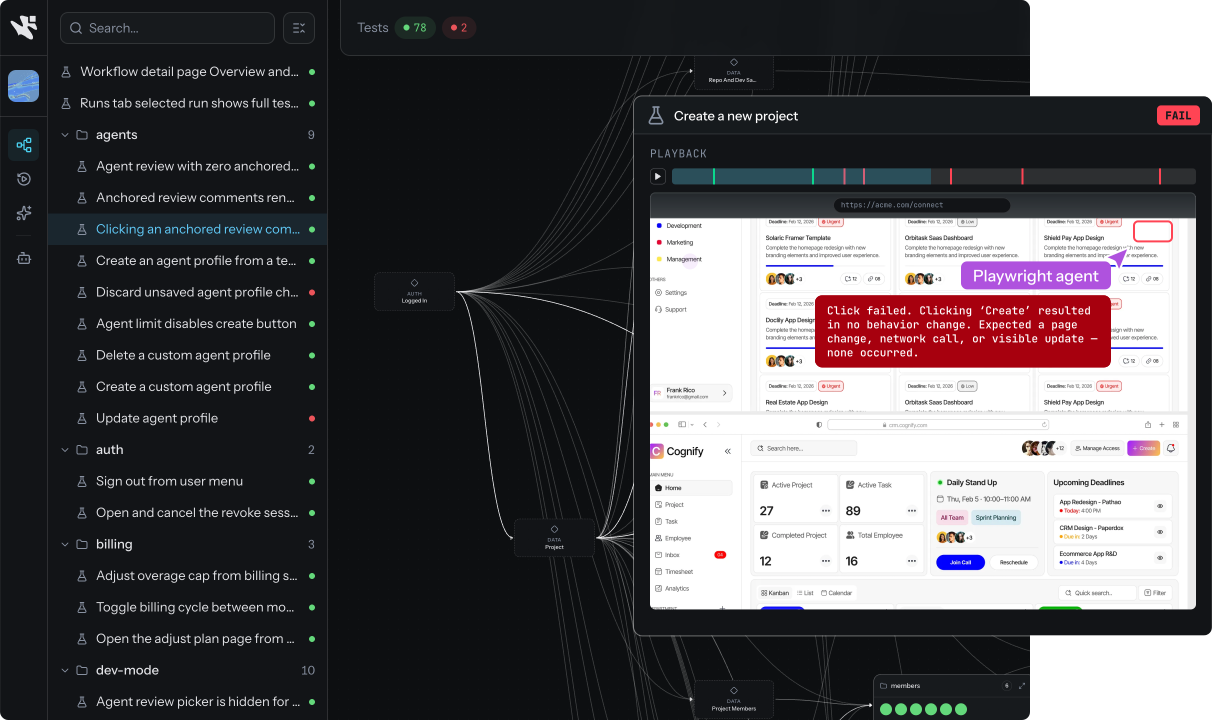
Ripplo tests full-stack
Our tests monitor both your app's state and your user interface for behavioral inconsistencies — catching the silent changes that don't crash but still break things. Replay-based tools test against saved responses from your old backend, so the new one is never in the loop. Ripplo drives the real app and checks what it actually wrote.
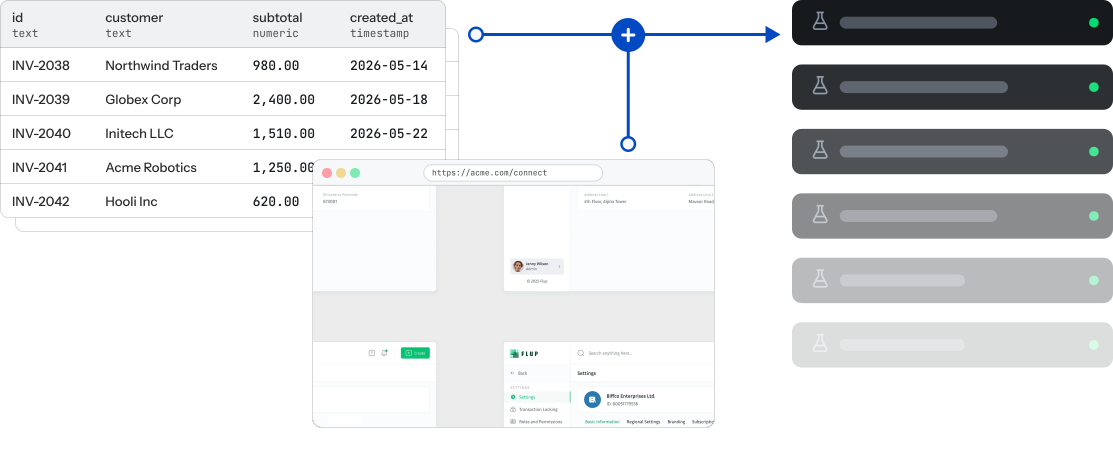
Why use Ripplo for your migration
Ripplo is purpose-built for backend migrations.
| Your situation | What Ripplo handles |
|---|---|
| Backend shifting under live workflows | Captures how workflows behave today, so you can confirm they still match after the migration |
| Need coverage to migrate safely | Builds the coverage for you — discovers your workflows, then writes the tests |
| Hard to tell real regressions from harmless noise | Every failure comes with a proof — a screen capture of the workflow and documented expected vs. actual behavior |
| No dedicated QA team catching silent regressions | Acts as your automated QA layer — breakages surface the moment they happen |
Ripplo is agentic at build-time but deterministic at run-time.
Discover
Ripplo guides your agentic developer tools (e.g. Claude Code) to discover your application's existing workflows. We validate workflow coverage using static analysis and telemetry.
Generate
Ripplo generates a comprehensive set of frontend and backend tests for each workflow.
Verify
Ripplo tests run as your migration progresses. If a change alters how a workflow behaves, you're alerted with a screen capture of exactly what broke.
Iterate
Ripplo captures new workflows and modifies them as you develop. New tests are added to future regression monitoring.
Built with your data policies in mind.
Staging only
Ripplo tests the environment you point it at — typically staging. Production data is only in scope if you point it there.
Stores test information only
Ripplo doesn't host your application. A review reads a copy of your code and deletes it when the review finishes. Recordings and screenshots come from your test environment only.
Retention
Run recordings are stored in Amazon S3 and kept until you close your organization or ask us to delete your data.
Model handling
Reviews run on large language models reached through OpenRouter. Organizations can point Ripplo at their own model endpoint instead. Details are on the security page.
Credential safeguards
The data-exposure reviewer flags mishandled credentials observed during a run.